Health & Safety
PFAS in Period Underwear: What to Look For
By Ashley Bolohan · April 25, 2026 · 9 min read
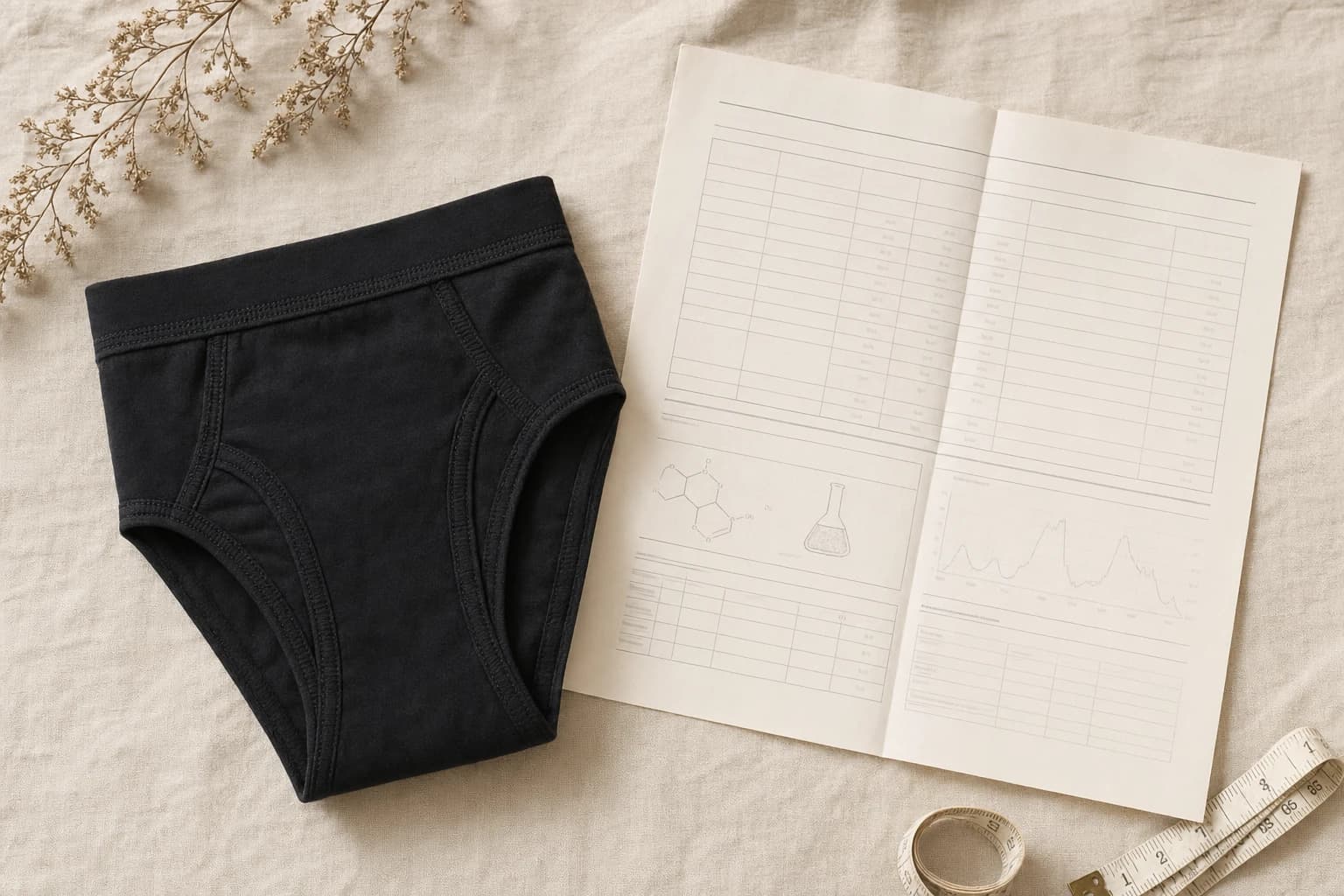
In late 2022, period underwear became one of the most publicly debated product categories in consumer health, after independent testing commissioned by environmental journalists found per- and polyfluoroalkyl substances — "PFAS," sometimes called "forever chemicals" — in the gusset of a leading brand. A class-action settlement followed, and a category that most people had only just discovered suddenly had a credibility problem to fix.
The good news: the science of how to test for PFAS in fabric is well understood. The complication: the way brands talk about those tests varies wildly. Some publish the lab's native PDF with the lab name, the report number, and the technician's signature visible. Others publish a screenshot with the lab cropped out. Most just write "PFAS-free" on a graphic and move on.
This guide is what we wish we'd had when we started WOVAE: a plain-English breakdown of how PFAS get tested, what the numbers on a lab report actually mean, and the questions you can ask any brand in the category to separate "PFAS-free because we said so" from "PFAS-free because the lab said so."
The short version
- PFAS got into period underwear through the gusset, where some brands historically used fluorinated chemistry to make fabric water-resistant. The cotton body of a brief almost never has PFAS as an intentional ingredient.
- Reputable labs use two methods, ideally together: a screen for total organic fluorine, and a confirmatory targeted PFAS panel that names each specific compound (PFOS, PFOA, PFNA, PFHxS, 6:2 FTS, 8:2 FTOH and so on).
- The single most important number on any "PFAS-free" claim is the reporting limit. "Non-detect at 10 ppb" is roughly 1,000 times stronger evidence than "non-detect at 10 ppm." The reporting limit should be stated next to the result. If it isn't, the claim is unverifiable.
- A credible report names the lab, has a unique report number you can call to verify, and is signed by a named technician. If any of those are missing, treat it as marketing, not testing.
Why this question even came up
In November 2022, a class-action lawsuit filed in New York alleged that Thinx period underwear contained PFAS despite marketing that promised "non-toxic" and "organic cotton" construction. Thinx denied wrongdoing but settled for a reported $5 million the following year. The case followed independent testing originally commissioned by Sierra Club and analyzed at the University of Notre Dame by Professor Graham Peaslee's lab — the same group that has published peer-reviewed PFAS investigations of school uniforms, cosmetics, food packaging, and outdoor apparel in Environmental Science & Technology.
Around the same time, a consumer health blog called Mamavation commissioned testing of period underwear from 17 brands and published results showing detectable fluorine across most of them. The numbers were imperfect — Mamavation's tests measured total organic fluorine at a 10 ppm reporting limit and didn't name the lab — but they put the issue in front of millions of readers, including plenty of women managing PCOS, endometriosis, and recurring UTIs who were already paying close attention to what touches their skin.
That's the context the entire category now operates in. If a period-underwear brand is making a claim about PFAS, you're right to ask for the receipts.
What PFAS actually are
PFAS — short for per- and polyfluoroalkyl substances — are a family of more than 12,000 synthetic chemicals built around extremely stable carbon-fluorine bonds. That stability is what makes them useful (they repel water, oil, and grease) and what makes them a problem (they don't break down in the environment or in your body). The EPA classifies the most-studied members, PFOS and PFOA, as likely human carcinogens. Other members are linked in epidemiological studies to thyroid disease, immune suppression, reduced birth weight, and ulcerative colitis.
In apparel, PFAS show up most often in coatings used for water- and stain-resistance: outdoor jackets, school uniforms with stain-treatment, and yes — the leakproof gussets in some period underwear. They are not a property of the fabric. They are a property of how the fabric was treated.
That distinction matters because it means PFAS in period underwear is a solved problem for any brand willing to use mechanical waterproofing instead of fluorinated chemistry — TPU film, cotton-and-polyurethane laminates, or a multi-layer absorbent stack with no PFAS-based water repellent at all.
The two ways labs test for them — and why it matters which one you see
There are two test methods you'll see referenced in credible textile lab reports.
Total organic fluorine (often abbreviated TOF) is the screen. The lab burns a sample of fabric in pure oxygen, captures the fluorine that's released, and measures the total. Standard: EN 14582:2016 with combustion ion chromatography. Reporting limits in textile work are usually around 20 parts per million (ppm). It's broad and useful for catching anything fluorinated. It will not tell you which specific PFAS are present.
Targeted PFAS analysis is the confirmation. The lab extracts the sample with methanol and runs it through liquid or gas chromatography paired with mass spectrometry (LC-MS/MS, GC-MS) to identify and quantify specific named compounds. Standard: EN ISO 23702-1:2018 (with EN 17681-1:2025 emerging as the textile-specific successor in Europe). EPA Method 1633 is the equivalent for water and biosolids and is now the de-facto reference in U.S. environmental testing. Per-analyte reporting limits typically run 1–10 parts per billion (ppb) — about 1,000 times finer than total fluorine.
A serious report uses both. The screen catches anything fluorinated. The targeted panel tells you whether what was caught is a PFAS we worry about, and at what concentration. If a brand only publishes total fluorine, you're seeing the screen. If they publish a long list of named PFAS analytes with CAS numbers and ppb reporting limits, you're seeing the actual confirmation.
The three numbers that decide whether a lab report is real
Once you know what method to expect, the report itself is easier to evaluate. Three numbers do most of the work.
1. The reporting limit, in the right units. A non-detect ("ND") result is meaningless without the limit next to it. ND at 10 ppb on a targeted PFAS panel is the strongest plausible result a textile sample can return. ND at 10 ppm on a total fluorine screen is fine, but it's a screen — about three orders of magnitude coarser. Always look for the units (ppm or ppb) in the same row as the result.
2. The lab's name and report number. Real lab certificates name the issuing lab (SGS, Eurofins, Galbraith, Intertek, Bureau Veritas, ALS), state the lab's ISO/IEC 17025 accreditation, and include a unique report number. You can — and should be able to — call the lab and verify the report number is real. Some brands crop the lab identity out of the screenshot they post. Treat that as a signal.
3. The signature. A lab certificate is not a certificate without a signed page. It will name the technician ("Assistant Technical Manager," or similar) and the lab entity they're signing on behalf of. Marketing summaries don't have signatures. Real lab paperwork does.
Tree Hugger Cloth Pads, a small Canadian period-care brand, posts the full SGS Hong Kong PDFs for each fabric layer in their period underwear. Lab name visible, report number visible, signed, sample photo on the last page. That's the format every brand in the category should be aiming at — and the one we've adopted for our own published reports at wovae.com/lab-results.
What "PFAS-free" should mean — and what brands often mean instead
Strictly, "PFAS-free" should mean: every PFAS analyte in a targeted lab panel returned below the lab's reporting limit, on the production batch you're actually buying, with the report published.
Loosely, it can mean any of the following:
- We don't intentionally add PFAS during manufacturing. (This is a sourcing claim, not a measurement.)
- We tested one sample, once, at some point in the past, and it came back clean. (Not the batch on your body.)
- Our supplier signed a declaration. (A document about a document.)
- We use mechanical waterproofing instead of fluorinated chemistry. (Often true and a strong design choice — but on its own, still not a measurement.)
None of these are bad practices. Several are necessary preconditions for a credible product. But they aren't the same as published per-batch testing, and a brand that conflates them is — at best — not being precise. At worst, it's the kind of language that attracted the Thinx lawsuit in the first place.
What to ask the brand
If you're evaluating a period-underwear brand and want to make the conversation specific, four questions get you most of the way:
- What lab tests your products, and at what reporting limit? Look for a named, ISO/IEC 17025-accredited lab and a per-analyte reporting limit in the parts-per-billion range.
- Do you test every production batch, or one sample once? Manufacturing varies; per-batch testing is the only way to catch a drift. Anything less is a one-time snapshot.
- Can I see the actual lab certificate for the batch I'm about to buy? The native PDF, not a screenshot. The lab name should be visible. A unique report number should be on the page. The technician's signature should be on the last page.
- Where do I find the test methods you use? You're looking for EN 14582:2016 (or equivalent) for total organic fluorine and EN ISO 23702-1:2018 (or EN 17681-1:2025, or EPA Method 1633) for targeted PFAS. "EPA-certified laboratory" without a method name is not a real answer.
Where WOVAE sits
We started WOVAE because we couldn't find the answers to those four questions for any brand we'd trust putting on the people we love. So we built the answers into the company.
Every WOVAE production batch is tested at SGS Hong Kong using both methods — EN 14582:2016 for total organic fluorine at a 20 ppm reporting limit, and EN ISO 23702-1:2018 for targeted PFAS at a 10 ppb per-analyte reporting limit. The body of the brief is 95% GOTS-certified organic cotton, and every finished piece is tested to OEKO-TEX STANDARD 100 Class I — the chemistry class required for clothing made for infants — so the certifications and the per-batch PFAS data are pulling in the same direction. The lab's native PDF goes on the site at /lab-results/{batch} with the batch number, test date, lab name, report number, every analyte tested, and the technician's signature. If a batch doesn't clear, that batch isn't sold — and we'd publish the failing report too.
We won't pretend that's a remarkable thing to do. It just happens to be uncommon. The full product-composition representation, including what "non-detect" legally means in our context, lives in our Terms of Service §7 if you want the careful version.
Last updated April 25, 2026. We update this article when new test methods are adopted or when our own published methodology changes. Sources: Sierra Club, Mamavation, Toxic-Free Future's "Toxic Convenience" report, Peaslee et al. (Notre Dame, 2022), Tree Hugger Cloth Pads' published SGS reports, EPA PFAS resources.
Frequently asked
Are period underwear safe?
Most are. The PFAS issue specifically came from a small number of brands using fluorinated chemistry to make their gusset water-resistant. Brands that use mechanical waterproofing (TPU film, cotton-and-polyurethane laminates) and publish per-batch lab tests have a much stronger safety story than brands that just put 'PFAS-free' on the label without the receipts.
What does 'PFAS-free' actually mean?
It depends on the brand. Strictly, it should mean every PFAS analyte in a targeted lab panel came back below the lab's reporting limit (often 10 parts per billion per analyte). Loosely, it means 'we didn't add any.' Those are very different statements. Always look for two things on the brand's site: which lab tested it, and what the per-analyte reporting limit was.
What does 'ND' or 'non-detect' on a lab report mean?
It means the substance was not detected at the laboratory's reporting limit. It does not mean the substance is mathematically zero. ND at 10 ppb is roughly 1,000 times stronger evidence than ND at 10 ppm — same word, very different signal. Always check the limit.
Is Thinx safe to wear now?
Thinx says they no longer treat finished products with PFAS, and the 2023 class-action settlement was about the prior product. Whether their current line is fully clean depends on what their published lab tests actually show today — which, as of writing, are not published per-batch. The same question applies to any brand making the claim.
Are organic cotton period underwear automatically PFAS-free?
Organic cotton itself isn't a source of PFAS. The risk is in the gusset, where some brands historically used PFAS-based chemistry for water resistance. Organic cotton + a mechanically waterproofed (non-fluorinated) gusset + a published lab test is the combination to look for.
Stay in the loop