Buying Guide
Period Underwear Fit, Absorbency & Sizing — A Buyer's Guide
By Ashley Bolohan · April 27, 2026 · 10 min read
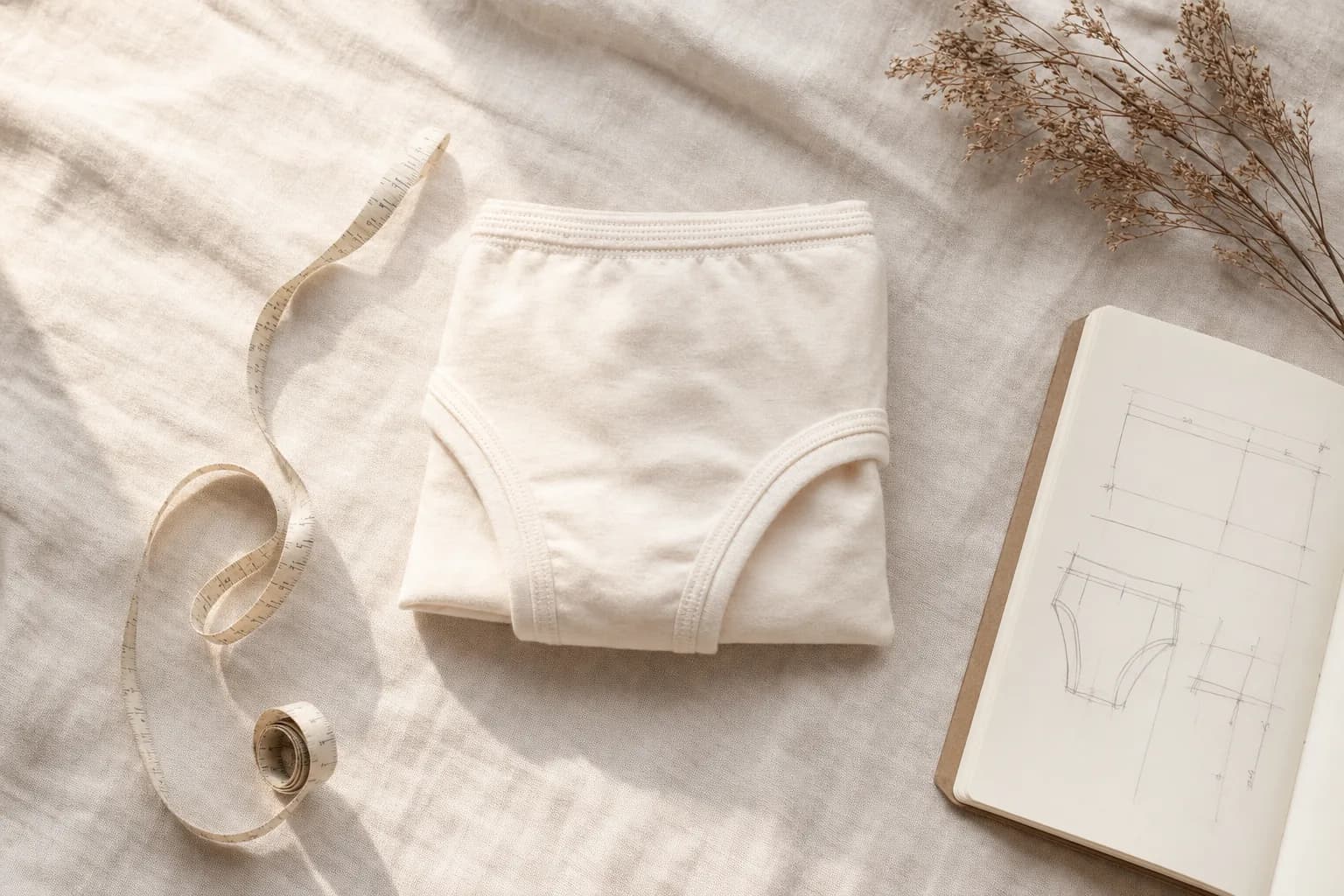
The two reasons people return period underwear are size and absorbency. Both are solvable up front — but the marketing in this category isn't always written to help you solve them.
Sizing charts vary brand to brand and across the same brand over time. Absorbency claims use a tampon-equivalency convention that no two brands measure identically. And the cut you pick — high-rise, mid-rise, hipster, thong — affects fit and comfort in ways that aren't intuitive until you've worn three.
This guide is the framework for getting the right size, the right absorbency, and the right cut on the first try — plus a plain-English breakdown of what's actually inside a period-underwear gusset, since the materials story is what determines whether the brief works the way the chart claims it does.
The short version
- Two measurements. Your natural waist (smallest part of the torso) and your fullest hip. Match both numbers to the brand's chart. If you're between sizes, size up — period underwear should not feel compressive.
- Three absorbency tiers. Light (~5 ml, ~1 tampon), moderate (~10 ml, ~2 tampons), heavy (~15+ ml, ~3+ tampons). WOVAE's period brief is moderate — backup-or-primary for spotting and light-to-medium days, not a heavy-flow replacement.
- Four-layer gusset. Cotton wicking → absorbent core → PFAS-free leakproof film → cotton facing. The skin contact surfaces are cotton on both sides.
- High-rise is the default. Sits above the natural waist, doesn't dig into bloat or post-procedure incisions, gives the gusset room to cover front-to-back leakage in any sleep position.
- First-pair fit guarantee. If the first pair doesn't fit, swap it free. The remaining pairs in a multi-pack are refundable only if unworn with tags (industry-standard hygiene rule).
How period-underwear sizing is different from regular underwear sizing
Standard underwear sizing in the U.S. tends to map loosely to dress size — XS for size 0–2, S for 4–6, M for 8–10, L for 12–14, XL for 16–18. It's a rough convention. Different brands stretch the size labels in different directions to flatter their target customer.
Period underwear has two pressures that change the conversation. First, the absorbent gusset is bulkier than a regular cotton-lined gusset, which means the brief needs slightly more room in the seat to lie flat without pulling. A perfectly-sized regular brief might feel snug around the gusset in a period brief from the same brand. Sizing up half a size is common.
Second, the brief should never be compressive on the natural waist. A regular brief can have a tighter waistband for shape reasons; a period brief shouldn't, because most people wearing it are wearing it during cycle days when bloat, cramping, or pelvic pain make compression at the waist actively uncomfortable. If your natural-waist measurement falls between two sizes, size up, not down.
The result is that for most people, the period-underwear size is half to one full size up from their regular underwear size. Worth checking the chart even if you've shopped the brand before.
How to measure yourself (5 minutes, soft cloth tape)
A soft fabric tape from the sewing notions aisle works fine. A piece of string + a ruler is a fallback.
- Natural waist. Stand straight, exhale normally, and find the smallest part of your torso — usually 1–2 inches above the navel for most body types. Wrap the tape horizontally around it, snug but not tight (you should be able to slide a finger underneath without pinching). Read the number where the tape meets.
- Fullest hip. Stand with feet together. Find the widest point around your hips and seat — usually 7–9 inches below the natural waist. Wrap the tape horizontally there. Read the number where the tape meets.
That's it. Hold both numbers against the brand's published sizing chart. WOVAE's chart (XS through 2XL) is on the product page and on the inside care tag of every pair we ship.
If your two measurements fall in different sizes — for example, waist measures S but hip measures M — choose the larger size. The smaller size will fit your waist but ride up at the hip; the larger will fit comfortably at both points.
Cuts and rises — what each does
Period underwear comes in roughly four common cuts. Each does a different job.
High-rise brief. Waistband sits at or above the natural waist. Best for sleeping (more coverage = more leakage protection in any position), bloat days, post-laparoscopy comfort, and anyone with a long torso. The default for almost every period brief on the market for a reason.
Mid-rise brief / hipster. Waistband sits 1–2 inches below the natural waist, on the upper hip. More casual feel, less coverage, fine for daytime light-flow days but less comfortable during cramps or with bloating.
Low-rise / bikini. Waistband sits at the lower hip. Looks invisible under low-rise jeans. Functionally the worst choice for period underwear because the waistband sits exactly on the lower abdomen where most pelvic conditions don't want pressure, and the cut limits how much absorbent gusset can be sewn in.
Thong / G-string. Limited gusset coverage, useful only for very light spotting under tight clothes. Not a primary period-day choice.
WOVAE makes one cut at launch — high-rise brief — for both the everyday and period briefs. Same silhouette, same fit. We chose this because the people we're building for (PCOS, endometriosis, recurring UTIs, sensitive skin) all benefit most from the same cut, and because launching a single shape we can fit-test exhaustively beats launching three shapes we can fit-test sloppily.
Absorbency tiers and what they actually mean
Absorbency labeling in period underwear has been a rough conversation for years. Brands use tampon-equivalents as the consumer-friendly unit, but the conversion to milliliters varies brand to brand because tampon sizes themselves vary. ASTM F3621-23, published in 2023 by ASTM International, is the first U.S. standardized test method for menstrual product absorbency. It uses a controlled syringe-and-saline test to give a repeatable ml number. Adoption is slow but real, and brands that follow it are easier to compare apples-to-apples.
The practical tiers, with rough ml ranges:
| Tier | ml capacity | Tampon equivalent | What it covers |
|---|---|---|---|
| Light | ~3–7 ml | ~1 regular tampon | Spotting, panty-liner replacement, end-of-cycle days, daily wear |
| Moderate | ~8–14 ml | ~2 regular tampons | Light-to-medium days, backup under tampons or cups, travel days, post-partum spotting |
| Heavy | ~15–25+ ml | ~3+ regular tampons | Medium-to-heavy days as primary, overnight use |
WOVAE's period brief is moderate — designed for spotting, light-to-medium days, and as backup to other products on heavier days. We don't claim it's a replacement for medical absorbency on heavy days. Per our Terms §6 the period brief is for light-to-moderate use; for heavy flow it's a backup, not a substitute.
If your typical day-3 flow soaks through a regular tampon in under three hours, you're heavy-flow that day and you want either a heavy-tier period underwear or a cup/tampon plus moderate underwear as backup. Don't try to make a moderate tier do heavy work — leakage during work or sleep is the most common return reason in the category, and it's almost always a tier mismatch, not a defect.
The four-layer gusset, decoded
Modern leakproof period briefs have four functional layers in the gusset. Cheaper or older designs collapse two of them. The four-layer construction, top to bottom:
Layer 1 — Wicking layer (against the skin). Cotton (in better designs) or polyester microknit (in older designs). Job: pull moisture away from the skin quickly so the surface in contact with you feels dry. WOVAE uses a cotton wicking layer because the skin contact surface is the most important variable for sensitive vulvar tissue.
Layer 2 — Absorbent core. A blend of cellulosic fibers — typically cotton plus viscose or bamboo viscose — that holds the actual volume. This is what determines the milliliter capacity of the brief.
Layer 3 — Leakproof barrier. A thin film that prevents fluid from passing through to your clothes. Two materials are used in the industry: TPU (thermoplastic polyurethane), which is mechanically waterproof through film geometry alone, and historically PFAS-based DWR coatings, which are chemically waterproof through fluorinated chemistry. WOVAE uses PFAS-free TPU only, never fluorinated chemistry — and we publish a per-batch lab test confirming it. See the PFAS guide for the full why.
Layer 4 — Outside-facing layer. Cotton on the outside of the absorbent stack, hidden inside the brief. Job: protect the leakproof film from abrasion and provide a cotton surface in contact with the rest of the brief's interior.
The result is cotton on both sides of the absorbent stack with a non-fluorinated leakproof film sandwiched in the middle. The skin never touches the synthetic film.
Sizing across XS–2XL — why our range exists
The fastest way to tell whether a brand cares about plus-size customers is to check whether their largest size is XL or 2XL+, and whether their published sizing chart actually lists waist/hip measurements for those sizes (not "available in XL/2XL" with no number behind it).
WOVAE launches in XS through 2XL with a published numerical chart for every size. We chose 2XL as the upper bound because the published 2023 NHANES data on adult U.S. women's measurements puts the median waist around 38–39 inches — a 2XL in most fit-aware DTC sizing — and a brand that stops at XL is excluding more than half its potential market by measurement-honest design.
The fit is engineered around three points: high-rise band that sits comfortably above the natural waist across all sizes, gusset width that scales proportionally with body width (so plus-size pieces aren't just smaller pieces stretched out), and leg openings that don't pinch the inner thigh. The same pattern is graded across all six sizes; nothing about the construction changes between XS and 2XL.
If you're a fit between sizes, we recommend sizing up. If the first pair doesn't fit, the first-pair fit guarantee covers an exchange at no cost — wear it, wash it, decide.
HSA / FSA on the period brief
Under current IRS guidance — established in 2020 by the CARES Act's expansion of qualifying medical expenses to include menstrual care products — absorbent period underwear is generally eligible for purchase using HSA (Health Savings Account) or FSA (Flexible Spending Account) funds. WOVAE's period brief qualifies under that guidance.
Eligibility ultimately depends on your individual plan administrator. We don't guarantee reimbursement; some plans require itemized receipts or specific product codes. Save the receipt; if your plan questions it, the IRS guidance citation is in §3702 of the CARES Act of 2020.
The everyday brief is not HSA/FSA-eligible — it's not a menstrual care product.
Returns and the first-pair fit guarantee
Period underwear is intimate apparel. The hygiene rule across the entire industry is that worn pieces aren't refundable — only exchangeable, and only when unworn pieces in the same order can be returned for refund. Anything else creates a hygiene problem the next customer eats.
Our exception to that rule is the 30-day first-pair fit guarantee. If the first pair in your order doesn't fit, we'll exchange it for a different size at no cost. You can wear it, wash it, decide. The remaining pairs in a multi-pack stay subject to the standard rule: refundable if unworn with tags, exchangeable (not refundable) if worn.
The first-pair guarantee exists because the size decision is the highest-friction part of buying period underwear for the first time. If we can't take that risk off the table, we don't expect you to take it for us.
Where WOVAE sits
Both WOVAE briefs are 95% GOTS-certified organic cotton with 5% elastane, sized XS through 2XL, in a single high-rise cut for both styles so the period brief and the everyday brief feel identical when worn. The period brief uses the four-layer construction described above with a PFAS-free TPU leakproof layer, tested per-batch and published at /lab-results. It's HSA/FSA-eligible.
If you're new to the category, the simplest path is: order one period brief in your measured size, wear it through one cycle, and use the first-pair fit guarantee to swap if needed before committing to a multi-pack. Five minutes with a tape measure beats a return.
Last updated April 27, 2026. Sources: ASTM F3621-23 (Standard Test Method for Determining the Absorbent Capacity of Disposable and Reusable Menstrual Products), CDC NHANES adult body-measurement data, IRS guidance on HSA/FSA eligibility under the CARES Act of 2020 (§3702), GOTS Global Organic Textile Standard fiber-content thresholds.
Frequently asked
How do I figure out my period underwear size?
Two measurements with a soft cloth tape: your natural waist (the smallest part of your torso, usually 1–2 inches above the navel) and the fullest part of your hips (usually 7–9 inches below the natural waist). Then check the brand's published sizing chart against both numbers. If you're between sizes, size up — period underwear should not feel compressive. WOVAE's range is XS through 2XL; the chart is on the product page and on the inside care tag of every pair.
What does 'moderate absorbency' actually mean?
There's no single industry-wide convention, which is why ASTM F3621-23 was published in 2023 as the first standardized U.S. test method for menstrual product absorbency. In practical terms: light = ~1 tampon equivalent (~5 ml), moderate = ~2 tampons (~10 ml), heavy = ~3+ tampons (~15+ ml). Most period underwear marketed as 'moderate' covers spotting, light-to-medium days, and serves as backup for tampons or cups on heavier days. WOVAE's period brief is moderate — designed for spotting, light-to-medium days, backup, and travel — not as a stand-alone replacement for medical-grade absorbency on heavy flow.
What's inside the gusset, layer by layer?
A modern leakproof period brief has four layers: (1) a cotton wicking layer against the skin that pulls moisture away quickly so you stay dry; (2) an absorbent core (typically a blend of cotton and viscose or other cellulosic) that holds the volume; (3) a leakproof barrier — in WOVAE's case a PFAS-free TPU film, never a fluorinated coating — that keeps fluid from passing through; and (4) a cotton facing on the outside-of-skin side. The skin contact surface is cotton on top and cotton on bottom of the absorbent stack. The PFAS-free leakproof layer is sandwiched in the middle and never touches the skin.
Why is high-rise the recommended cut for period underwear?
Three reasons. First, the waistband sits above any natural bloat line, so it doesn't dig in on cramp days or PCOS bloat days. Second, the larger fabric area gives more room for the absorbent gusset to be cut wide enough at the front and back to catch leakage in any sleeping position. Third, the higher cut after a C-section or laparoscopic procedure (common in endometriosis treatment) sits above the incision sites rather than directly on them. Low-rise period underwear exists but is functionally a compromise — the waistband sits exactly where most pelvic pain conditions don't want pressure.
What if the size I order doesn't fit?
WOVAE has a 30-day fit guarantee on the first pair: wear it, wash it, decide. If it doesn't fit, we'll exchange it for a different size at no cost. For multi-packs, the remaining unworn pairs are refundable within 30 days; worn pairs can be exchanged but not refunded (industry standard for intimate apparel — see our Terms §5). The first-pair guarantee is meant to take the size-decision risk off the table for anyone trying period underwear for the first time.
Stay in the loop